
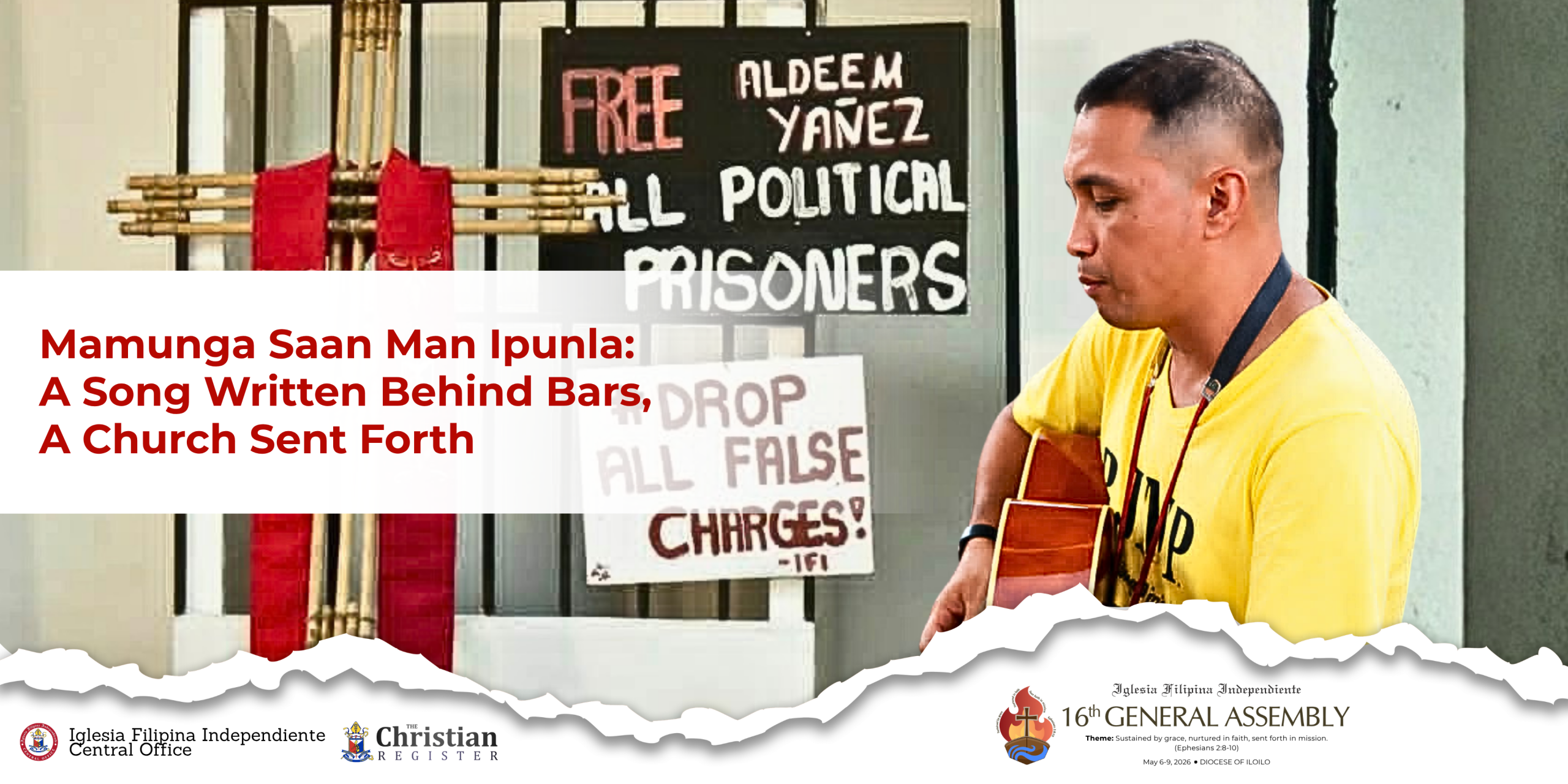
When the delegates of the Iglesia Filipina Independiente rose to sing the official theme song of the 16th General Assembly, they were singing words written in a jail cell.
Mamunga ka saan man ipunla — bear fruit wherever you are planted. The line landed differently knowing where it came from.
Deacon Aldeem Yañez has been behind bars since April 10, 2022, when state security forces raided his home in Barangay Iponan, Cagayan de Oro on a Palm Sunday morning and arrested him on charges of illegal possession of firearms and explosives and terrorism financing. The IFI and his family have consistently denied the charges, calling them fabricated — part of a broader pattern of red-tagging and legal harassment directed at church workers, human rights defenders, and activists in the country.
Yañez is not new to this. He has been arrested before — in 2018 in General Santos City, in 2020 in Agusan del Sur. The charges were dismissed both times. This time, he has been waiting for more than four years without conviction.
A Musician Who Would Not Be Silenced
Long before he became a political prisoner, Yañez was a church worker and a musician. He served as national president of the Youth of the IFI from 1999 to 2002, was elected Vice Chairperson of the National Council of Churches in the Philippines, and spent decades doing development work and peacebuilding in Visayas and Mindanao through the IFI’s regional office. He was, by every account, a man armed not with weapons but with his music and faith.
Inside the Cagayan de Oro City District Jail, he continued to be exactly that. He led the jail band. He wrote songs. He released an album — Gawasnon, meaning Freedom — songs of struggle, hope, and faith composed from within prison walls.
When the IFI began preparing for its 16th General Assembly, it turned to Yañez for the theme song. What he gave the Church was “Mamunga Saan Man Ipunla” — a song that does not flinch from the reality of hard ground.
Saan man ipunla, saan man ihasik, sa patag at gilid, sa bundok na matarik. Mabato man, masukal, maputik o matinik — wherever the seed is planted, wherever it is sown, on flat land or hillside, on a steep mountain. Rocky, overgrown, muddy, thorny — it does not matter. The seed is called to bear fruit.
That a man writing from detention chose not bitterness but fruitfulness as his message says something about both the composer and the Church he belongs to, and he was writing for.
Ordained Behind Bars
In April 2025, while his case remained unresolved, Yañez was ordained a deacon of the Iglesia Filipina Independiente inside the Cagayan de Oro City District Jail. He became the first political prisoner to be ordained to the diaconate of the IFI — joining his two brothers in the three-fold ministry of the Church. His brothers — Bishop Redeemer Yañez and Fr. June Mark Yañez — preceded him into ordained ministry.
The ordination drew broad ecumenical support. Two IFI bishops were present. The Roman Catholic Archbishop of Cagayan de Oro attended. The Archbishop Emeritus sent his congratulations. A representative of the United Church of Christ in the Philippines was there. The jail, for a moment, became a cathedral.
“Regardless of the circumstances, we are called to serve God wherever we are,” Yañez said.
The Song and the Church
The second verse of the song calls the faithful to something more demanding than personal piety. Makipamuhay at makiisa, umugat, umusbong sa api at aba — live among the people, be one with them, take root and grow among the oppressed and the lowly. Sa paglalakbay at pakikibaka para sa kalayaan — in the journey and the struggle for freedom.
This is the IFI’s language. It has always been. Founded in 1902 in the crucible of colonial resistance, the Iglesia Filipina Independiente has never understood the Gospel as something separate from the conditions in which people live. Its mission has always moved between the sanctuary and the street, between the sacraments and the struggle for human dignity.
The third verse of the song names the cost of that mission plainly. Sa gitna ng unos, ng hirap at dusa — in the midst of storm, of hardship and suffering. Magpakatatag, magtiwala sa masa — stand firm, trust in the people. Ang butil ng buhay na inalay sa kapwa — the seed of life offered to one’s neighbor — magbubunga ng liwanag at bagong umaga — will bear fruit in light and a new morning.
A Church That Has Not Forgotten
At the close of the 16th General Assembly, the IFI issued a statement calling for the immediate release of Deacon Aldeem Yañez. They noted that he has been in detention for more than four years without conviction. They called on the Commission on Human Rights to conduct an inquiry, on the courts to resolve his bail application without further delay, and on the Office of the President to end the practice of red-tagging.
The IFI also expressed concern about a court order to transfer Yañez’s detention from Cagayan de Oro to a facility in Taguig — a move his legal counsel has opposed, arguing that it would effectively prevent him from participating in his own defense. A motion for reconsideration was filed in February 2026 but was denied in April.
“The IFI has lost its own to this machinery,” the statement said. “We will keep watch. We will keep praying. We will keep standing.”
Wherever the Seed Is Planted
The chorus of “Mamunga Saan Man Ipunla” ends not with freedom but with hope — mamunga ka ng pag-asa, bear fruit in hope. And in its final line, the word changes: mamunga ka ng paglaya — bear fruit in liberation.
It is a song that knows perseverance and hope. It does not pretend the soil is easy. It does not promise the storm will pass quickly. It asks only that the seed — wherever it finds itself — bear fruit.
For the Iglesia Filipina Independiente, gathered in its 16th General Assembly, the song was both a commission and a confession: that the church is called to bear fruit not in ideal conditions but in the conditions it actually inhabits — rocky, thorny, muddy, steep.
And that the seed of life offered to one’s neighbor will, in time, bear fruit in light and a new morning.
Deacon Aldeem Yañez is still waiting for his freedom. But he has already given the Church its song.
Mamunga ka saan man ipunla.