
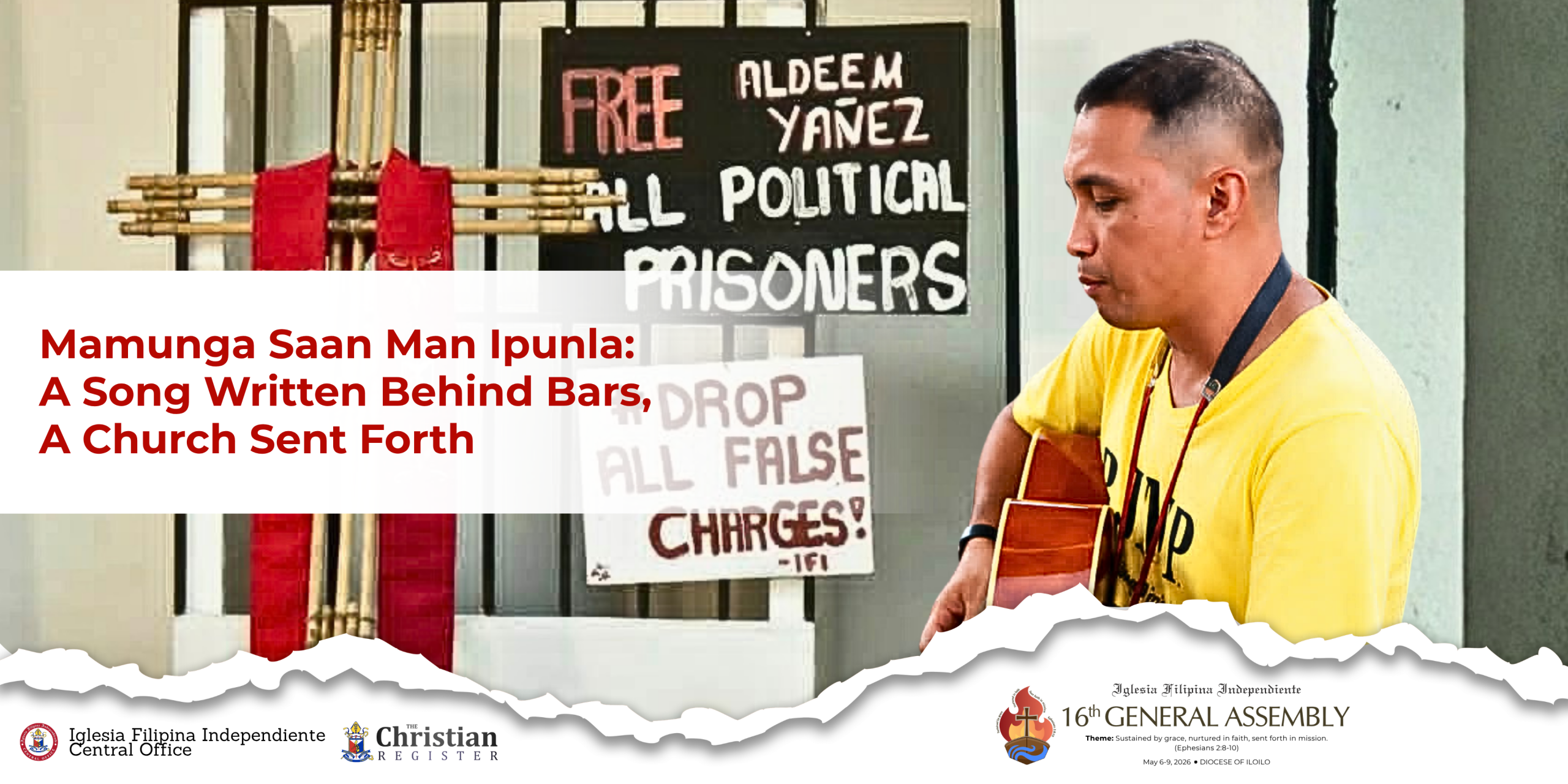
When the delegates of the Iglesia Filipina Independiente rose to sing the official theme song of the 16th General Assembly, they were singing words written in a jail cell. Mamunga ka saan man ipunla — bear fruit wherever you are planted. The line landed differently knowing where it came from. Deacon Aldeem Yañez has been behind bars since April 10, 2022, when state security forces raided his home in Barangay Iponan, Cagayan de Oro on a Palm Sunday morning and arrested him on charges of illegal possession of firearms and explosives and terrorism financing. The IFI and his family have consistently denied the charges, calling them fabricated — part of a broader pattern of red-tagging and legal harassment directed at church workers, human rights defenders, and activists in the country. Yañez is not new to this. He has been arrested before — in 2018 in General Santos City, in 2020 in Agusan del Sur. The charges were dismissed both times. This time, he has been waiting for more than four years without conviction. A Musician Who Would Not Be Silenced Long before he became a political prisoner, Yañez was a church worker and a musician. He served as national president of the Youth of the IFI from 1999 to 2002, was elected Vice Chairperson of the National Council of Churches in the Philippines, and spent decades doing development work and peacebuilding in Visayas and Mindanao through the IFI’s regional office. He was, by every account, a man armed not with weapons but with his music and faith. Inside the Cagayan de Oro City District Jail, he continued to be exactly that. He led the jail band. He wrote songs. He released an album — Gawasnon, meaning Freedom — songs of struggle, hope, and faith composed from within prison walls. When the IFI began preparing for its 16th General Assembly, it turned to Yañez for the theme song. What he gave the Church was “Mamunga Saan Man Ipunla” — a song that does not flinch from the reality of hard ground. Saan man ipunla, saan man ihasik, sa patag at gilid, sa bundok na matarik. Mabato man, masukal, maputik o matinik — wherever the seed is planted, wherever it is sown, on flat land or hillside, on a steep mountain. Rocky, overgrown, muddy, thorny — it does not matter. The seed is called to bear fruit. That a man writing from detention chose not bitterness but fruitfulness as his message says something about both the composer and the Church he belongs to, and he was writing for. Ordained Behind Bars In April 2025, while his case remained unresolved, Yañez was ordained a deacon of the Iglesia Filipina Independiente inside the Cagayan de Oro City District Jail. He became the first political prisoner to be ordained to the diaconate of the IFI — joining his two brothers in the three-fold ministry of the Church. His brothers — Bishop Redeemer Yañez and Fr. June Mark Yañez — preceded him into ordained ministry. The ordination drew broad ecumenical support. Two IFI bishops were present. The Roman Catholic Archbishop of Cagayan de Oro attended. The Archbishop Emeritus sent his congratulations. A representative of the United Church of Christ in the Philippines was there. The jail, for a moment, became a cathedral. “Regardless of the circumstances, we are called to serve God wherever we are,” Yañez said. The Song and the Church The second verse of the song calls the faithful to something more demanding than personal piety. Makipamuhay at makiisa, umugat, umusbong sa api at aba — live among the people, be one with them, take root and grow among the oppressed and the lowly. Sa paglalakbay at pakikibaka para sa kalayaan — in the journey and the struggle for freedom. This is the IFI’s language. It has always been. Founded in 1902 in the crucible of colonial resistance, the Iglesia Filipina Independiente has never understood the Gospel as something separate from the conditions in which people live. Its mission has always moved between the sanctuary and the street, between the sacraments and the struggle for human dignity. The third verse of the song names the cost of that mission plainly. Sa gitna ng unos, ng hirap at dusa — in the midst of storm, of hardship and suffering. Magpakatatag, magtiwala sa masa — stand firm, trust in the people. Ang butil ng buhay na inalay sa kapwa — the seed of life offered to one’s neighbor — magbubunga ng liwanag at bagong umaga — will bear fruit in light and a new morning. A Church That Has Not Forgotten At the close of the 16th General Assembly, the IFI issued a statement calling for the immediate release of Deacon Aldeem Yañez. They noted that he has been in detention for more than four years without conviction. They called on the Commission on Human Rights to conduct an inquiry, on the courts to resolve his bail application without further delay, and on the Office of the President to end the practice of red-tagging. The IFI also expressed concern about a court order to transfer Yañez’s detention from Cagayan de Oro to a facility in Taguig — a move his legal counsel has opposed, arguing that it would effectively prevent him from participating in his own defense. A motion for reconsideration was filed in February 2026 but was denied in April. “The IFI has lost its own to this machinery,” the statement said. “We will keep watch. We will keep praying. We will keep standing.” Wherever the Seed Is Planted The chorus of “Mamunga Saan Man Ipunla” ends not with freedom but with hope — mamunga ka ng pag-asa, bear fruit in hope. And in its final line, the word changes: mamunga ka ng paglaya — bear fruit in liberation. It is a song that knows perseverance and hope. It does not pretend the soil is easy. It does not promise the storm will pass quickly. It asks only that the seed — wherever it
‘𝗚O FORTH TO ENGAGE THE WORLD’ | IFI General Assembly makes Prophetic Stand for Peace, Justice and National Renewal
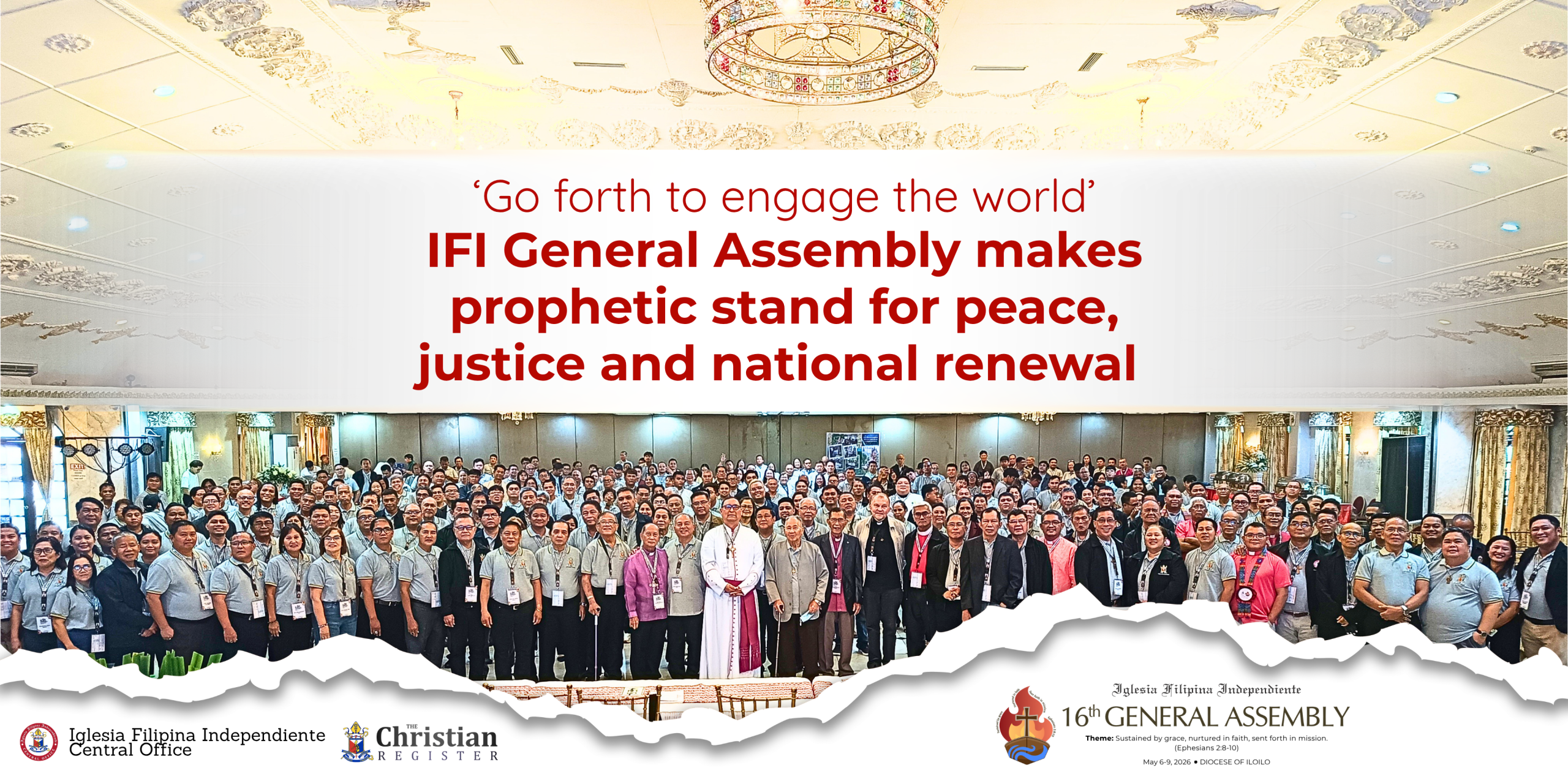
The 16th General Assembly (GA) of the Iglesia Filipina Independiente (IFI) concluded in Iloilo City with the approval of statements reaffirming the Church’s commitment to prophetic witness, human dignity, justice and mission in the life of the nation. Gathering on May 6-9, 2026, under the theme, “Sustained by Grace, Nurtured in Faith, Sent Forth in Mission,” clergy and lay delegates from 53 dioceses reflected on the Church’s role amid growing social, political and ecological challenges. “[The GA was] a manifestation of ecclesial maturity, and collective discernment within the life of the Church,” said Rev. Laarni Salaguinto, a delegate from the Diocese of Rosales (Eastern Pangasinan). “Beyond the formal deliberations and institutional processes, what became evident to me was the Church’s continuing desire to remain faithful to its prophetic vocation amid the complex social and spiritual realities of our time.” 𝗙𝗿𝗲𝗲 𝗬𝗮𝗻𝗲𝘇 Among the statements approved by the assembly was a strong expression of concern on the continued detention of Deacon Aldeem Yañez, imprisoned for more than four years now without conviction. The Deacon, a former national president of the Youth of the Iglesia Filipina Independiente and vice chair of the National Council of Churches in the Philippines, faces charges of illegal possession of firearms and explosives, and terrorism financing — charges unjustly punishing his work for just peace and community development. “We pray for Deacon Aldeem, for his family, and for this nation, that dignity may be the birthright of every Filipino, and that peace may be built on justice,” the statement said. “We will keep watch. We will keep praying. We will keep standing.” The assembly asked the court system to observe due process in the case of Deacon Yañez, grant his application for bail and stop his transfer to Taguig for terrorism-financing charges to allow him to stay in Cagayan De Oro, where his support system is. The statement also asked Congress to reexamine anti-terrorism legislation in the Philippines, and dissolve the National Task Force to End Local Communist Armed Conflict, which has been responsible for the broad crackdown on dissent, activism and development work in the guise of communist rebellion. 𝗣𝗼𝗹𝗶𝘁𝗶𝗰𝘀 𝗼𝗳 𝗰𝗵𝗮𝗻𝗴𝗲 The assembly also released a statement encouraging responsible and transformational 2028 national elections. “[The] structural problems remain. Dynasties dominate. Vote-buying is rampant. Red-tagging silences dissent. Corruption bleeds public resources dry. The poor remain excluded,” the statement said. “The 2028 elections present an opportunity…” The statement urged Filipinos to pursue what it called a “Politics of Change” that “stands against the patronage politics of traditional politicians — the politics of guns, goons, and gold.” While reiterating that the Church did not endorse candidates, the statement called on aspiring public officials to reject political dynasties, vote-buying, corruption and impunity. It also outlined a people’s agenda focused on human rights, ecological justice, national sovereignty, social protection, and genuine democracy. “We call on our clergy and lay leaders to facilitate discernment in their communities; creating spaces where the faithful can reflect, discuss, and decide as people of faith, not as clients of political patrons,” said the statement. 𝗦𝗽𝗲𝗮𝗸𝗶𝗻𝗴 𝗶𝗻 𝗹𝗼𝘃𝗲 The agenda echoed concerns in a separate statement on national issues. “We speak — not as a political party, not in pursuit of power, not on behalf of any faction or interest — but as a community of faith obligated to the God who made every human being in the divine image, and to the nation whose people we are called to serve,” it said. “We speak because we cannot be silent. And we speak in love — for the nation, for its people, and even for those whose decisions we must challenge.” Central to the assembly’s concluding message was the affirmation that the Church’s life and mission were grounded in God’s grace. “We leave … as a people who know where we have come from and where we are being sent,” it said. “We are a Church emboldened in every generation — not by our own achievements, not by the strength of our institutions, not by the favor of the powerful — but by the grace that has sustained us, the faith that has formed us, and the mission that has always defined us.” Delegates acknowledged both the witness and the shortcomings of the Church, including the persistence of clericalism, failures in accountability, and the need to strengthen safeguarding and inclusion within Church communities. The statement also called IFI toward deeper repentance, ongoing formation, and a mission that moves beyond institutional maintenance toward solidarity with the poor, marginalized, and oppressed. In the statement, Church leaders committed to “go forth to engage the world with both discernment and integrity, neither naïve nor cynical, but deeply rooted in Christ’s love, committed to justice, and alive to the God who goes before us.” “More than resolutions and official statements, I believe the Assembly leaves us with a renewed ecclesiological vision that calls every member of the Church toward deeper solidarity, courageous witness, and transformative service to the people of God,” said Rev. Salaguinto.