
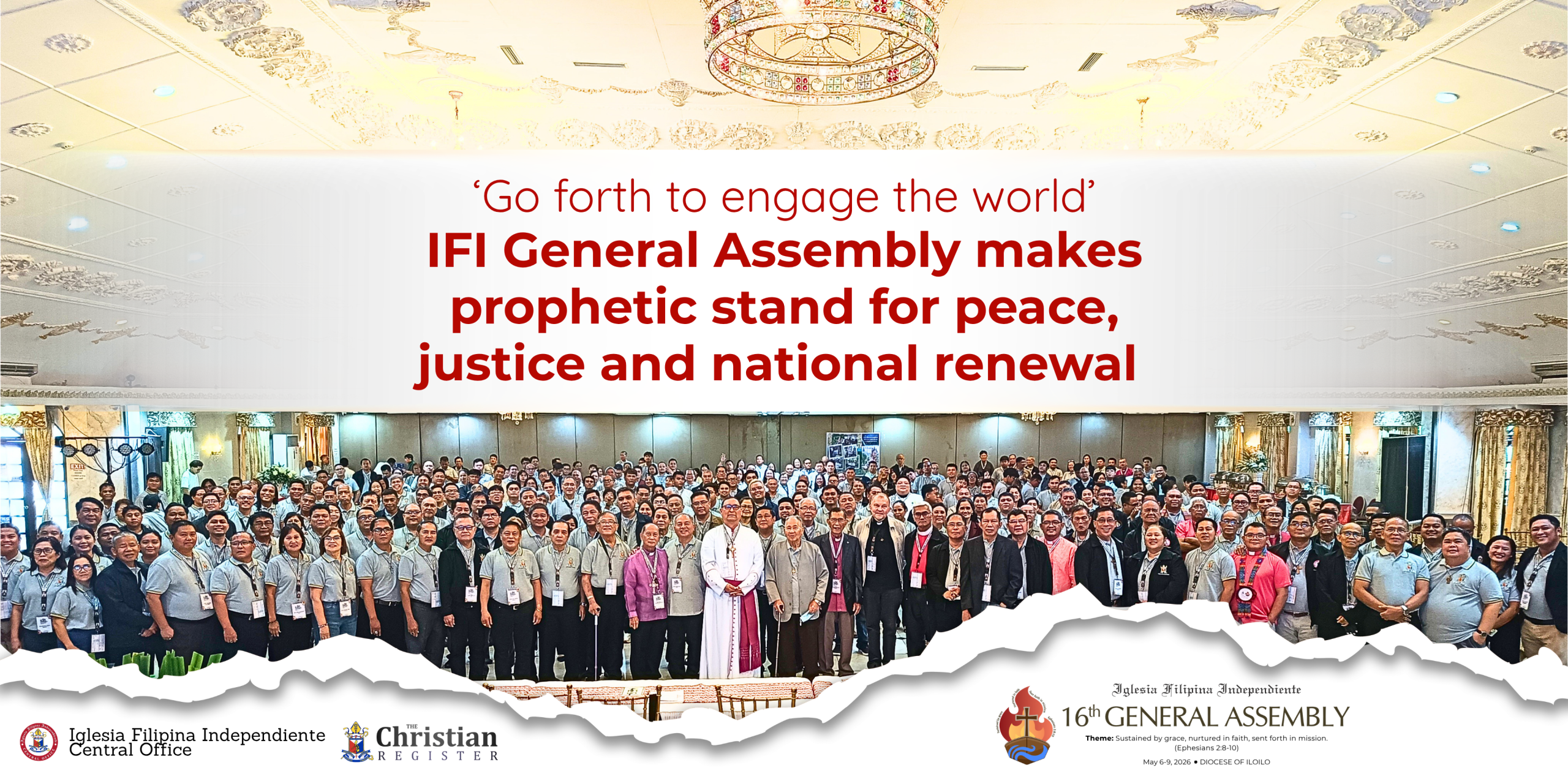
The 16th General Assembly (GA) of the Iglesia Filipina Independiente (IFI) concluded in Iloilo City with the approval of statements reaffirming the Church’s commitment to prophetic witness, human dignity, justice and mission in the life of the nation.
Gathering on May 6-9, 2026, under the theme, “Sustained by Grace, Nurtured in Faith, Sent Forth in Mission,” clergy and lay delegates from 53 dioceses reflected on the Church’s role amid growing social, political and ecological challenges.
“[The GA was] a manifestation of ecclesial maturity, and collective discernment within the life of the Church,” said Rev. Laarni Salaguinto, a delegate from the Diocese of Rosales (Eastern Pangasinan). “Beyond the formal deliberations and institutional processes, what became evident to me was the Church’s continuing desire to remain faithful to its prophetic vocation amid the complex social and spiritual realities of our time.”
𝗙𝗿𝗲𝗲 𝗬𝗮𝗻𝗲𝘇
Among the statements approved by the assembly was a strong expression of concern on the continued detention of Deacon Aldeem Yañez, imprisoned for more than four years now without conviction.
The Deacon, a former national president of the Youth of the Iglesia Filipina Independiente and vice chair of the National Council of Churches in the Philippines, faces charges of illegal possession of firearms and explosives, and terrorism financing — charges unjustly punishing his work for just peace and community development.
“We pray for Deacon Aldeem, for his family, and for this nation, that dignity may be the birthright of every Filipino, and that peace may be built on justice,” the statement said. “We will keep watch. We will keep praying. We will keep standing.”
The assembly asked the court system to observe due process in the case of Deacon Yañez, grant his application for bail and stop his transfer to Taguig for terrorism-financing charges to allow him to stay in Cagayan De Oro, where his support system is.
The statement also asked Congress to reexamine anti-terrorism legislation in the Philippines, and dissolve the National Task Force to End Local Communist Armed Conflict, which has been responsible for the broad crackdown on dissent, activism and development work in the guise of communist rebellion.
𝗣𝗼𝗹𝗶𝘁𝗶𝗰𝘀 𝗼𝗳 𝗰𝗵𝗮𝗻𝗴𝗲
The assembly also released a statement encouraging responsible and transformational 2028 national elections.
“[The] structural problems remain. Dynasties dominate. Vote-buying is rampant. Red-tagging silences dissent. Corruption bleeds public resources dry. The poor remain excluded,” the statement said. “The 2028 elections present an opportunity…”
The statement urged Filipinos to pursue what it called a “Politics of Change” that “stands against the patronage politics of traditional politicians — the politics of guns, goons, and gold.”
While reiterating that the Church did not endorse candidates, the statement called on aspiring public officials to reject political dynasties, vote-buying, corruption and impunity. It also outlined a people’s agenda focused on human rights, ecological justice, national sovereignty, social protection, and genuine democracy.
“We call on our clergy and lay leaders to facilitate discernment in their communities; creating spaces where the faithful can reflect, discuss, and decide as people of faith, not as clients of political patrons,” said the statement.
𝗦𝗽𝗲𝗮𝗸𝗶𝗻𝗴 𝗶𝗻 𝗹𝗼𝘃𝗲
The agenda echoed concerns in a separate statement on national issues.
“We speak — not as a political party, not in pursuit of power, not on behalf of any faction or interest — but as a community of faith obligated to the God who made every human being in the divine image, and to the nation whose people we are called to serve,” it said. “We speak because we cannot be silent. And we speak in love — for the nation, for its people, and even for those whose decisions we must challenge.”
Central to the assembly’s concluding message was the affirmation that the Church’s life and mission were grounded in God’s grace.
“We leave … as a people who know where we have come from and where we are being sent,” it said. “We are a Church emboldened in every generation — not by our own achievements, not by the strength of our institutions, not by the favor of the powerful — but by the grace that has sustained us, the faith that has formed us, and the mission that has always defined us.”
Delegates acknowledged both the witness and the shortcomings of the Church, including the persistence of clericalism, failures in accountability, and the need to strengthen safeguarding and inclusion within Church communities.
The statement also called IFI toward deeper repentance, ongoing formation, and a mission that moves beyond institutional maintenance toward solidarity with the poor, marginalized, and oppressed.
In the statement, Church leaders committed to “go forth to engage the world with both discernment and integrity, neither naïve nor cynical, but deeply rooted in Christ’s love, committed to justice, and alive to the God who goes before us.”
“More than resolutions and official statements, I believe the Assembly leaves us with a renewed ecclesiological vision that calls every member of the Church toward deeper solidarity, courageous witness, and transformative service to the people of God,” said Rev. Salaguinto.